Thursday, 21 February 2019

Why You Should Work Less and Spend More Time on Hobbies


As professionals around the world feel increasingly pressed for time, they’re giving up on things that matter to them. A recent HBR article noted that in surveys, most people “could name several activities, such as pursuing a hobby, that they’d like to have time for.”
This is more significant than it may sound, because it isn’t just individuals who are missing out. When people don’t have time for hobbies, businesses pay a price. Hobbies can make workers substantially better at their jobs. I know this from personal experience. I’ve always loved playing the guitar and composing. But just like workers everywhere, I can fall into the trap of feeling that I have no time to engage in it. As head of demand generation for Nextiva, I have enough on my plate to keep me busy around the clock. I can easily fall into the trap of the “72-hour workweek,” which takes into account time people spend connected to work on our phones outside of official work hours.
When I crash, there’s always the temptation to do something sedentary and mindless. It’s little surprise that watching TV is by far the most popular use of leisure time in the U.S. and tops the list elsewhere as well, including Germany and England.
But by spending time on music, I boost some of my most important workplace skills.
Creativity. To stand out and compete in today’s crowded and constantly changing business environment, organizations need new, innovative ideas that will rise above the noise. I’m tasked with constantly looking for new ways to attract attention from potential buyers. But coming up with a fully original idea can be difficult when your mind is filled with targets, metrics, and deadlines.
A creative hobby pulls you out of all that. Whether you’re a musician, artist, writer, or cook, you often start with a blank canvas in your mind. You simply think: What will I create that will evoke the emotion I’m going for?
It’s no surprise that by giving yourself this mental space, and focusing on feelings, you can reawaken your creativity. Neuroscientists have found that rational thought and emotions involve different parts of the brain. For the floodgates of creativity to open, both must be in play.
Perspective. One of the trickiest tasks in the creative process is thinking through how someone else would experience your idea. But in doing creative hobbies, people think that way all the time. A potter imagines how the recipient of a vase would respond to it. A mystery novelist considers whether an unsuspecting reader will be surprised by a plot twist.
When I take a break from work to go make music, I reconnect with that perspective. I keep thinking about how someone hearing my song for the first time might respond. I do all I can to see (or hear) the world through someone else’s eyes (or ears). Then, when I resume the work project, I take that mentality with me.
Confidence. When I face a tough challenge at work and feel stymied, I can start to question whether I’ll ever figure out a successful solution. It’s easy to lose creative confidence. But after an hour of shredding on the guitar, hitting notes perfectly, I’m feeling good. I can tell that my brain was craving that kind of satisfaction. And when I face that work project again, I bring the confidence with me.
It turns out people like me have been studied. In one study, researchers found that “creative activity was positively associated with recovery experiences (i.e., mastery, control, and relaxation) and performancerelated outcomes (i.e., job creativity and extrarole behaviors).” In fact, they wrote, “Creative activity while away from work may be a leisure activity that provides employees essential resources to perform at a high level.”
So to my fellow professionals, I highly recommend taking some time to keep up your creative hobby. It doesn’t have to be long. A study found that spending 45 minutes making art helps boost someone’s confidence and ability to complete tasks.
I also suggest you encourage your business to celebrate employees’ hobbies. Zappos puts employee artwork up on its walls and encourages people to decorate their desks in whatever ways they wish. Some businesses hold talent shows. Even employees who may not have these kinds of talents should be encouraged to do something that feels creative and fun. Some CEOs spend time on their own hobbies, setting the right example.
And when you find a little time for a creative hobby break, make it guilt free. After all, when you do this, everyone stands to gain.
Source: HBR 07 Feb, 2019

Wednesday, 13 February 2019

CEO of Vodafone Business to join Cognizant as CEO


His appointment will be effective from April 1, 2019. Following his appointment, Francisco D'Souza, who co-founded Cognizant and has served as CEO since 2007, will serve as full-time Executive Vice Chairman.
Information technology company Cognizant has announced that it has named Brian Humphries, currently the CEO of Vodafone Business, as its CEO and a member of the Board of Directors. Humphries' appointments will be effective April 1, 2019.
Following Humphries' appointment, Francisco D'Souza, who co-founded Cognizant and has served as CEO since 2007, will serve as full-time Executive Vice Chairman to facilitate the transition through June 30, 2019. Thereafter, he will remain on the Board as Vice Chairman.
As CEO of Vodafone Business, Humphries has been responsible for its global enterprise, consisting of all business-to-business fixed and mobile customers, as well as Vodafone's Internet of Things, Cloud-Hosting, Carrier Services and Security Solutions. 
Vodafone Business is part of Vodafone Group, one of the world's largest telecommunications companies. During his time leading Vodafone Business, the division accounted for nearly a third of the Vodafone Group's service revenue with approximately €12 billion in sales globally. Humphries previously held leadership positions at global technology leaders Dell and Hewlett-Packard.
"With a strong track record of success across different companies, cultures and roles, Brian is the right executive to lead Cognizant and build on its 25 years of growth, success and innovation," said Michael Patsalos-Fox, Cognizant's Chairman of the Board. "Our industry is entering a dynamic new growth stage. Brian is a broadly experienced technology executive with a proven track record of driving enterprise-wide transformation through focused execution, often in challenging and highly competitive market segments. Brian brings a global perspective and a keen knowledge of our businesses and the technologies with which we innovate. We're confident he has the ideas, energy, ambition and insights to extend the remarkable track record of success under Frank's leadership."
"It is an honor and a privilege to join Cognizant, which has been at the forefront of the digital revolution – driving innovative and transformational change for many of the largest enterprises in the world," said Humphries. 
"Cognizant is renowned for being laser-focused on its clients' needs, developing business solutions and services that help clients position their companies for the future. I look forward to building on the great work and collaboration Cognizant has with clients, the development of innovative solutions and its operational execution and strength. The opportunity to lead Cognizant is an exciting one."
D'Souza said, "During my 25 years at Cognizant, including the last 12 as CEO, and the last seven months as Vice Chairman, I've had a bird's-eye view of the world-changing technology revolution that is reshaping how we work, live and play. Cognizant has been fortunate to play a leading role in that transformation. While I have enjoyed serving as CEO, I believe this is the right time for me to step aside and for the Company to name a new leader to build on the strong foundations we've created and take Cognizant into the future."
D'Souza added, "The Company has the strategy and people in place to continue to deliver innovative technologies and solutions that help our customers realize their full potential in a digital world. I know Brian will help Cognizant deliver on its commitments to our clients and continue to build value for our shareholders. I am committed to continuing to support Cognizant as we make this transition and beyond as Vice Chairman of the Board. I want to thank Michael Patsalos-Fox and our fellow Board members for their support and my many colleagues for their engagement and hard work, which have made Cognizant the success it is today."

Brian Humphries' Experience and Expertise

Brian Humphries joined Vodafone from Dell where he most recently held the position of President and Chief Operating Officer of its Infrastructure Solutions Group, based in Boston and Geneva. Previously, he was President of Dell's Global Enterprise Solutions, a group with approximately $15 billion in revenue, and before that he was Vice President and General Manager, EMEA Enterprise Solutions.
Before joining Dell, Humphries was with Hewlett-Packard where his roles included Senior Vice President, Emerging Markets; Senior Vice President, Strategy and Corporate Development; and Chief of Staff to the Chairman and Chief Executive. He also served as Chief Financial Officer of HP Services. The early part of his career was spent with Compaq and Digital Equipment Corporation.
He received his Bachelors of Business Administration with Honors, from the University of Ulster in 1996.  
Source: People matters 07 Feb, 2019

Thursday, 7 February 2019

Future Libraries : Usage of technology, innovation and creativity

I will start this post with a video from a public library from Toronto, Canada


The function of libraries will evolve in accordance with our world. For example, it has been suggested that libraries will cease to be places where content is collected and mediated, but will instead be recognized as a place where institutionally-created content is curated. Elsewhere, it has been argued that traditional perceptions of the library as mere collectors of information objects needs to be vigorously challenged so that libraries are recognized as the place to go in search of support in the process of converting information into new knowledge.

Technology continues to evolve, and as it does it is becoming more and more integrated with society.. Smart appliances and voice controlled assistants are just two examples of how technology is evolving to make people’s lives easier. As technology changes the way we manage our lives, will it also affect the way libraries are managed?

Lets see few technologies for future libraries

1. Library bookmark and guide

Image result for toout

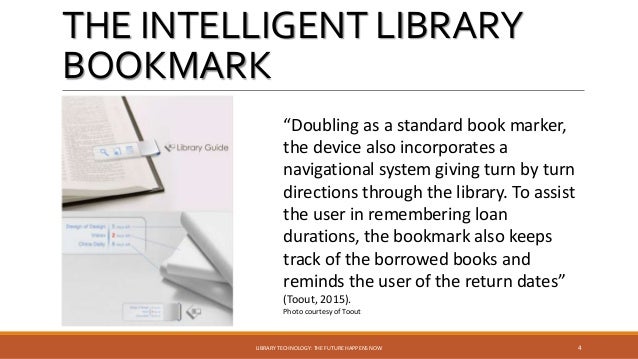
An interesting concept from a Chinese design company Toout. This little tiny device is in the first place a regular bookmark. But on top of that it also has features that could make using the library much easier.
First of all, the device would be a perfect companion when navigating through the library, by giving turn-by-turn directions to the book the patron wants.The device could also keep track of all borrowed books, as well as remind the user of the return dates.

2. Augmented reality apps

librARi is a concept of an image based augmented reality application, created by Pradeep Siddappa. A lot has been said about using augmented reality in libraries, but there are few examples that would let us actually see it. The app would point you to the new arrivals. It would also be able to find and point to similar books. Simple, but useful, and very probable.

3. Book delivery drone

Image result for book delivery drone

To get the book from a library, you can either go and find it, or you can let it find you. The future belongs to unmanned flying machines, and just like Amazon drones can deliver the goods to customers, libraries could deliver the books to patrons.
Library drone is not even the close future. It’s already happening. Australian start-up Flirtey has teamed up with a book rental service Zookal to create – the first in the world – textbook delivery system.

4. Digital interface for print books

Image result for Digital interface for print books

Anyone who tried e-books would never give up the convenience of a digital interface and all other helpful tools. Searching the content of the book (including smart search), looking for a reference on the web, getting an instant translation, writing notes, or collecting book passages – all this can be done on the same device that we use to read an e-book. We can obviously borrow an ebook instead of a print book, but here is a better idea – enhance the print book with a digital interface.

Finger Link is a project currently developed by Fujitsu that will let you use digital tools to work with a printed book.

5. Print on demand machines

Image result for Print on demand machines

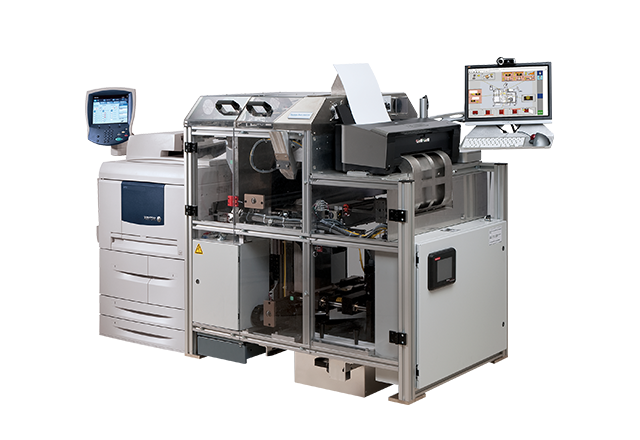
Bookless libraries, where you can’t find a single print book, launch regularly. They obviously won’t kill traditional libraries, just like e-books don’t kill print books. The digital-only route has its disadvantages.

To me, every digital-only library should offer their patrons the ability to instantly make a print version of the book. Let’s put aside the question who is going to pay for this. The most important question is that sometimes the book has to be real to make use of it.

Futuristic Libraries

Innovations will also lead to advancements in digital data management that will result in more accurate subject search results and citations while enabling libraries to more effectively curate and display relevant resources.

Libraries are going through a renaissance(transformation or rebirth), both in terms of the social infrastructure they provide and in terms of a diversification of the services and experiences offered. In corporate environments they are playing an increasingly important role in the provision of collaborate workspace and innovation. In communities they are evolving into hubs for education, health, entertainment and work. 

Wednesday, 30 January 2019

IQ vs EQ: How to find the right balance


Artificial Intelligence and Machine Learning have acquainted us with a welcome change that has recoupled the lost quality of human interactions practiced in legacy assessment tools.
The past few years have seen a radical change not only in the way individuals use technology but also in the way corporates purpose it. Technology has transformed the way we go through our routines and the same can be said of the corporate world as well. Technology has enabled corporates and firms to assess prospective as well as the current employees, to optimize their crew for better productivity and efficiency. The hiring process too is going through a structural overhaul with all the technological advancements. While the fundamentals of hiring have remained the same, technology has made the process more efficient. 
Artificial Intelligence and Machine Learning have acquainted us with a welcome change that has recoupled the lost quality of human interactions practiced in legacy assessment tools. Automation allows for risk assessment from amongst a pool of distinct candidates. The biggest advantage that AI has brought to the table is the ability to hold unbiased while examining a large quantum of data, ensuring the results stay accurate, efficient and fair. Analysing data can also help recruiters learn from past experiences faster, and learn from the tiny details while recruiting, such as scheduling appointments, sending out reminders, amongst others. This ensures that recruiters can focus on preparing well with the interview questions, to judge the technical know-how as well as the emotional intelligence of interviewees. 
Recruiters now save 75% of their time as they can focus on the important bits rather than dissipating their energy on scheduling and rescheduling interviews. Given this, what are the recruiters looking for in candidates? Mere technological know-how will not do. Companies deploy a large quantum of resources while hiring and inducing the employees. Technical know-how will only help them grasp the concepts, while employers need to understand if the candidate can coalesce well in the environment. Can the prospective employee judge the situations in this regard staying in tandem with their peers' emotions and act accordingly? Are they a team player? The aptitude to fit into the company’s work atmosphere plays a key role. 
Knowing the difference
The use of aptitude and knowledge tests have been a standard practice across the industry and have become an important and integral part of the overall hiring process.
Aptitude is both technical skills as well as soft skills and gives companies an opportunity to take a more informed decision. The trend amongst recruiters currently is to choose candidates who have a healthy attitude towards their career goals over a candidate who only has the technical know-how. It is important for recruiters to understand the importance of having a balance of skill and attitude in an employee. 
There is no use of hiring a person who is a go-getter and has high professional ethics if he has no technical knowledge. It would also be useless to hire someone who has vast technical knowledge but cannot gauge the social cues or cannot communicate his thoughts in a comprehensive manner. The amount of time and money spent by companies on training their fresh recruits is no secret. These two situations are on either end of the scale and cause a huge loss to the organization.
Recruiters must focus more on finding employees with the right aptitude for the role they are being hired for. Interview questions must be curated in a way that they test the intelligence quotient as well as the emotional quotient of the candidate. While situation analysis helps recruiters understand how candidates solve problems while understanding how they handle their peers in difficult situations; testing for their verbal as well as written comprehension skills helps in analysing the communication skills of the candidate. 
Incorporating questions that are a mix of the above techniques ensure that the recruiter is able to accurately arrive at an unbiased answer to whether the candidate is a good or a bad hire. Many recruiters fail to assess the emotional intelligence and other such exigent soft skills. Traditional hiring models only consider the technological know-how, with degrees and marks as the benchmark to assess if the candidate is a good hire or not. 
While a person’s technical know-how is no less important and is the primary asset of a candidate, the paradigm shift in the hiring model sees more companies now pursuing candidates with soft skills. There has been a shift in hiring based on cultural fit over skill sets. Candidates are assessed on their problem-solving abilities, mental abilities, their ability to work within a team, communication and emotional intelligence. Companies have realised that there is a certain aptitude in each candidate and unless that aptitude matches that of the organization's needs, the hire is futile. 
A cohesive workforce is a valuable asset for any company and mapping the candidates to the job vacancies often marks the beginning of what is known as employee-relationship-management. Whilst a sound job description helps potential employees understand their roles and responsibilities, an aptitude test can help employers identify the right fits and plan their future goals.
Source: People matters