Tuesday, 13 March 2018

Beautiful Libraries in the World


Rampur Raza Library, Uttar Pradesh, India
The Rampur Raza Library is one of the world’s beautiful library registered as a national monument, the 18th-century Rampur Raza Library in Rampur, Uttar Pradesh, has been a powerhouse of Indo-Islamic studies since its founder, ruler Nawab Faizullah Khan, set it up in 1774. The collection, which started as his private one, has been added to over the years, and includes manuscripts and palm leaves with inscriptions on. It’s open every day except Friday. It contains very rare and valuable collection of manuscripts, historical documents, specimens of Islamic calligraphy, miniature paintings, astronomical instruments and rare illustrated works in Arabic and Persian languages besides 60,000 printed books.
The Raza library Journal is published every year. It contains research articles of noted literateurs of Urdu. The contributors whose views were included in the Journal belonged to senior scholars and university professors, academicians and the research scholars of library. The Journal has become very popular in India and abroad due to its academic standard and vivid illustrations etc.


Bibliotheca Alexandrina, Alexandria

Bibliotheca Alexandrina is dedicated to recapture the spirit of openness and scholarship of the original Bibliotheca Alexandrina. It is much more than a library 
The Library of Alexandria was reborn in October 2002 to reclaim the mantle of its ancient namesake. It is not just an extraordinarily beautiful building; it is also a vast complex where the arts, history, philosophy, and science come together. Bibliotheca Alexandrina, turning it into a global cultural hub with donations from all around the world – Italy helping with the preservation of manuscripts, Greek lending a hand with antiquities and Americans chipping in with computers, according to National Geographic.The library, which calls itself a “centre for learning, tolerance, dialogue and understanding”, hosts art exhibitions, workshops, has four museums – and is steadily building a collection of up to five million books.


Library of Congress
The Library of Congress (LOC) is the research library that officially serves the United States Congress and is the de facto national library of the United States. It is the oldest federal cultural institution in the United States. The Library is housed in three buildings on Capitol Hill in Washington, D.C.; it also maintains the Packard Campus in Culpeper, Virginia, which houses the National Audio-Visual Conservation Center.
The Library of Congress claims to be the largest library in the world. Its "collections are universal, not limited by subject, format, or national boundary, and include research materials from all parts of the world and in more than 450 languages. Two-thirds of the books it acquires each year are in languages other than English."
Although the Library is open to the public, only high-ranking government officials and Library employees may check out books and materials (except through Interlibrary loan, which is available to the public. The Library promotes literacy and American literature through projects such as the American Folklife Center, American Memory, Center for the Book, and Poet Laureate.


Old Library, Trinity College, Dublin

Trinity College Dublin is right in the heart of Dublin and well served by cross city buses. The DART stations of Pearse Street, Tara Street and Connolly Station are a short walk away. The Book of Kells is Ireland's greatest cultural treasure and the world's most famous medieval manuscript. The 9th century book is a richly decorated copy of the four Gospels of the life of Jesus Christ. Trinity College Dublin will bring visitors back to the 18th century, when the magnificent Old Library building was constructed and which displays the Book of Kells.


Bodleian Library and Divinity Schools, Oxford  

Libraries in the Bodleian Libraries group include major research libraries, libraries attached to faculties, departments and other institutions of the University and, of course, the principal University library – the Bodleian Library – which has been a library of legal deposit for 400 years. The Bodleian Library is one of the oldest libraries in Europe. The library was rescued by Sir Thomas Bodley (1545–1613), a Fellow of Merton College and a diplomat in Queen Elizabeth I’s court.


BibliotecaMediceaLaurenziana, Florence

The BibliotecaMediceaLaurenziana, belonging to the Italian Ministerodei Beni e delleAttivitàCulturali e del Turismo is an international research library specializing in the conservation and study of its manuscript and rare book collections.


Austrian National Library, Vienna

The Austrian National Library regards itself as a centre of information and research oriented toward serving the public, as an outstanding national memory institution and as a multi-faceted centre of education and culture. The Austrian National Library is also authorised to collect and archive Austrian web publications or web publications with an Austrian connection, and to make these available for use. A goal of the Austrian National Library is to open itself up to as broad a circle of interested persons as possible. To fulfil this, there are, among other things, regular exhibitions to raise awareness of the holdings and – partly in cooperation with other cultural and educational institutions – events such as readings, book presentations, symposia, and concerts. Together with these and other activities, the Austrian National Library not only fulfils its legal commission to educate, but also expresses its own chosen role as a faceted and multicultural centre of education and culture.


Klementinum Library, Prague

Royal retreat with marble flooring and intricately carved wooden Corinthian columns between the bookshelves, it’s an extraordinarily flamboyant space – with the scalloped balcony and gilded rails adding extra bling to the mezzanine level. Today, the main room is filled with antique globes and clocks as well as books, books and more books.


Tianjin Binhai Library

The five-level library has a total space of 33,700 square metres. It features floor-to-ceiling, terraced bookshelves able to hold 1.2 million books, and a large, luminous sphere in the center that serves as an auditorium with a capacity of 110 people. The library is nicknamed 'The Eye' because the sphere, which appears like an iris, can be seen from the park outside through an eye-shaped opening.

In the first week after opening day, approximately 10,000 people a day came, causing queues outside.

The first and second floors contain mainly lounge areas and reading rooms. The floors above have computer rooms, meeting rooms, and offices. There are also two rooftop patios. Because of a decision to complete the library quickly and a conflict with what was officially approved, the main atrium cannot be used for book storage; the rooms providing access to the upper tiers of shelving were not built and book spines were printed onto the backs of the shelf space for the opening-day photographs.


Monday, 5 February 2018

How to Ask for a Promotion


Asking for a promotion can be nerve-wracking. But when you think you’re ready for the next step, it’s important to say so. How do you prepare for that conversation with your boss? What information should you have at the ready? And how exactly do you make your case?
What the Experts Say

“Asking for a promotion makes you feel vulnerable,” says 
Sabina Nawaz, the global CEO coach, leadership keynote speaker, and writer. “You’re not in control; you’re putting yourself in the hands of your manager to be judged — and you might be judged not worthy.” You may fret that you’ll be “bugging your boss” or come across as greedy and “self-serving.” But, to advance in your career, you’ll need to learn to advocate for yourself, says Joseph Weintraub, the founder and faculty director of the Babson Coaching for Leadership and Teamwork Program. “You can’t assume that the organization will take care of you just because you do a good job,” he says. “There is a degree of self-promotion that’s needed.” Put simply: “if don’t you ask, you don’t get.” Here are some pointers on how to make the request.

Source: HBR JANUARY 29, 2018


Wednesday, 13 December 2017

Interesting Guinness world records related to Books/Libraries


The most people participating in a reading at a single venue


The most people participating in a reading relay at a single venue is 3,071, achieved by Library Marwadi Education Foundation (India), in Gujarat, India, on 22 September 2015. All participants read from An Autobiography Or The Story of my experiments with truth By M. K. Gandhi. (Details)


Youngest Author


Youngest author of a bestselling book series

Christopher Paolini (USA), born 17 November 1983, is the youngest author of a bestselling book series. With sales in excess of 20 million copies as of May 2011, the Inheritance Cycle, which consists of the books Eragon, Eldest, Brisingr, and Inheritance, due for release on 8 November 2011, continues to be a firm favourite of fantasy fans the world over. (Details)

Youngest person to write a published book (female)

The youngest commerciallly published female author is Dorothy Straight (b. 25 May 1958), of Washington, DC, USA, who wrote How the World Began in 1962, aged 4. It was published in August 1964 by Pantheon Books.(Details)

Youngest person to write a published book (male)

The record for the youngest published male author is 4 years and 356 days and was achieved by Thanuwana Serasinghe (Sri Lanka), who released his book Junk Food on 5 January 2017.(Details)


Largest collection of miniature books


The largest collection of miniature books consists of 3,137 unique books and belongs to Sathar Adhoor (India), The collection was verified in Thrissur, India, on 4 June 2016.(Details)


Thickest book published


The thickest published book measures 322 mm (12.67 in) in width and was unveiled by HarperCollins in London, UK, on 20 May 2009. All Agatha Christie's Miss Marple stories - 12 novels and 20 short stories - are collected and published in this volume. The book contains 4,032 pages and weighs 8.04 kg. (Details)


Largest Book


The largest book measures 5 m x 8.06 m (16.40 ft x 26.44 ft), weighs approximately 1500 kg (3,306 lb) and consists of 429 pages. The book was unveiled by Mshahed International Group, in Dubai, UAE, on 27 February 2012.(Details)


Highest library from ground level


The highest library from ground level is situated at 230.9 m (757 ft 6 in), on the 60th floor of the JW Marriott Hotel at Tomorrow Square in Shanghai, China. The library was opened at the same time as the hotel on 7 November 2003.(Details)

Largest library book fine paid


The world´s largest fine for an overdue library book is $345.14 (£203.29), the amount owed at two cents a day for the poetry book Days and Deeds checked out of Kewanee Public Library, Illinois, USA in April 1955 by Emily Canellos-Simms. Although the book was due back 19 April 1955, Emily found it in her mother´s house 47 years later and presented the library with a check for overdue fines.(Details)

Friday, 8 December 2017

Why We Still Need Libraries in the Digital Age

"I don't have to look far to find treasures, I discover them every time I visit a library."

-Michael Embry

There is romanticism to the imagery of libraries as hallowed temples of learning, protected from the ephemeral nature of the digital age. Many people seem to believe that the digital age is about to render libraries and all of those hard copy books on the bookshelves useless. Yes, it is true that you can discover almost anything you could imagine from the internet...the key word in that sentence is "almost." But there are still things that libraries and librarians can offer for us that typing a few things into Google on our smartphones and laptops cannot.

1. Libraries offer much more than many people even realize


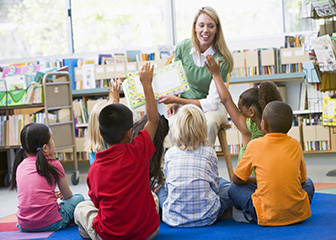
Libraries are no longer just about walking in and checking out a book and being on your way. Libraries also offer things like computer and internet access, access to printers and fax machines, audiobooks, DVDs, and some even offer computer classes and special activities for children to get them more involved in reading.

As reported by the National Archives research, libraries reach a much broader range of age groups and social backgrounds compared to other types of cultural activities. Consequently, the library represents something different for each one of us. It can be a peaceful place for insightful work for professionals, a playground for families or even an information point for those with limited resources and much more. Still, there is one aspect everyone agrees on: the library is a neutral and secure public space.

2. Libraries are FREE


This is one instance where the word "free" actually means free as long as you return whatever you borrow on time and in good condition. Yes, you can go online and purchase whatever book you are looking for, but why do that when you can borrow and read it for free? All of those things I just mentioned above are offered to anyone who chooses to walk in those doors. This can be incredibly helpful for people with a limited income who may not have access to these things at home. It doesn't matter who you are or what your financial situation is. As soon as you walk into a library, you are treated the same as everyone else and have the same opportunities as everyone else.

3. Librarians are extremely helpful

Image result for librarian vs software jokes

Can't find something you're looking for? I bet your librarian can find it for you in a heartbeat. Have a question? I bet your librarian either has the answer or will go out of their way to find the answer for you. They are there to help you, all you have to do is ask. No Software can replace the expertise of a librarian.

4. Libraries are becoming technology hubs

As the Internet becomes the main vehicle for people to get information, the tradition of a building stuffed with books is less relevant to our modern lives. As a result, libraries are transforming themselves into technological spaces. When looking at technology use in libraries, the Pew Research Internet Project found that patrons are increasingly thinking of libraries as community spaces that allow access to technology and as a source of digital literacy for various demographics.

5. Finding books on a shelf

Image result for library self

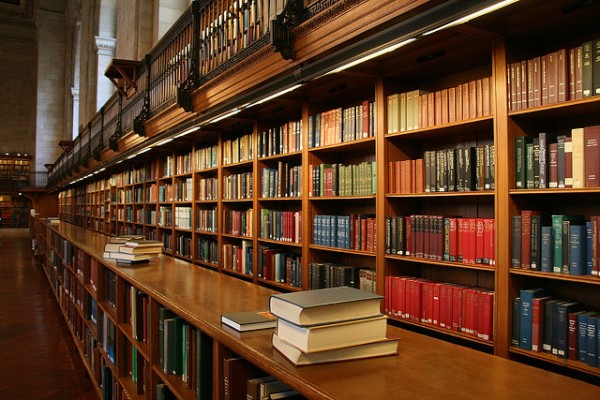
Printed books still dominate reading, despite the growth of e-books. Yes, I do own a Kindle Fire, and yes, I do enjoy reading on it...but I still enjoy reading hard copies of books and sometimes I actually prefer it. There is something to be said for holding an actual book in your hand. Plus, when you go to a library and search for a specific book on a shelf, you never know what else you might actually find. You could find the book you were searching for, and also find a book that looks even more interesting to you right next to it.

The number of e-book uses in growing, but not to the extent that electronic books have replaced printed versions. While the percentage of adults who are reading e-books is growing, simultaneously, print book reading is also growing as are adults listening to audio books. The popularity of e-books is rising, but print remains the foundation of many people’s reading habits. This trend is expected to change as-reader ownership expands, but the love affair with an actual book isn’t expected to vanish completely.

6. How can you be sure what you are reading online is true?

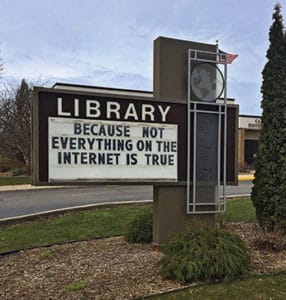
It is true, the internet can provide you with information on basically anything you want to know...but the internet is also full of fake articles and news sites. A simple search on Google or Bing can bring up multiple different responses for the same subject. Some of these are written by professionals who actually know what they are talking about, but some are also written by people who may not know as much about what they are talking about and are just voicing their personal opinions. It can often be hard to differentiate who is who. I myself have experienced how extremely difficult this can be if you are researching for a school project or a paper you have to turn in for a grade. How do you know that all of this information is actually true? If you are looking for reliable information, a library is probably your best bet. In a library, you will find reference and non-fiction sections which contain factual information that is written, edited, and published by professionals in that specific field of study.

References :
https://princh.com/4-critical-spaces-every-modern-library-must-have/#.WipplEqWbIU
https://www.globalcitizen.org/en/content/five-ways-libraries-are-changing-in-the-digital-ag/
https://www.theodysseyonline.com/why-libraries-are-still-important?altdesign=socialux
https://www.britishcouncil.org/voices-magazine/why-still-need-public-libraries-digital-age
https://www.newsroom.co.nz/@future-learning/2017/04/13/18929/why-do-we-still-need-libraries